


Sign Nesting Benchmark: 33% Less Material on Average
Table of Contents
Tighter sign nesting is found margin. We benchmarked SSQ autonesting against a traditional layout across 18 real fabricated-lettering jobs, and it used ~33% less material on average - up to 57% on the hardest geometry. That saving happens automatically on every quote, and it is yours to keep as margin or pass on to win the work.
What a 33% Material Saving Does to Your Margin
A third less material is a direct, recurring boost to your bottom line, because material is a hard cost on every single job. Cut it by ~33% and you have two good options on every quote: bank the difference as extra profit, or pass it on as a lower price and win work you would have lost. You did nothing extra to earn it - the nesting ran itself.
Take a shopfront set of flat-cut acrylic letters. Laid out the traditional way, with each letter dropped onto the sheet as drawn, the job needs 3 sheets of 10mm acrylic at $190 a sheet: $570 in material. Nested tightly, the same letters pack onto 2 sheets: $380. That is $190 saved on one job - the benchmark-average third off your material bill.
| What you do with the saving | Outcome on a $570 material job |
|---|---|
| Keep it | +$190 margin, on every job, automatically |
| Pass it on | Quote ~$190 lower at the same margin - win more work |
| Split it | Sharper price and fatter margin |
On a job you were winning anyway, that $190 is pure margin. On a job you are fighting for, it is $190 of room to undercut the shop down the road still nesting by hand. This is the same first-principles thinking behind our complete guide to sign pricing: every cost component is calculated from real geometry, so the saving is real, not a rounding trick.
Ready to automate your sign shop quoting?
See how SwiftSignQuote can save you hours on every quote.
Book a 30-minute demo to see how SwiftSignQuote can transform your business.
We Benchmarked Our Nesting Against a Traditional Layout
To put a real number on it, we ran a controlled benchmark. We set the word "SwiftSignQuote" in 7 different typefaces at four cap heights (300mm to 800mm) - 18 letter sets in total - then measured the sheet material each one consumed on standard 2440 x 1220 mm production sheets, two ways: a traditional "as-drawn" layout (letters placed in reading order, the way most shops lay a job out by hand) versus SSQ autonesting. Both figures are net of any reusable standard-size offcut.
The typefaces were chosen to span the full range of real signage geometry, from clean geometric sans to heavy display faces to flowing connected scripts:
- Script and connected - Great Vibes, Pacifico (the contour-heavy end)
- Display and decorative - American Sportfishing, Coca-Cola
- Workhorse sans - Roboto, Bebas Neue

This is the same approach we apply to real fabricated lettering, where every letter is a different shape with its own returns and joinery - see our flat-cut vs fabricated 3D letters guide for how that geometry drives cost.
The Results: 6% to 57% Less Material, on Every Layout
Every one of the 18 layouts used less material when nested - the only question was how much. The average saving was about a third, and the spread was wide because it tracks the geometry of the lettering, not the size of the job.
| Metric | Result |
|---|---|
| Average material saved | ~33% per layout |
| Median | 39% |
| Range | 6% to 57% |
| Layouts that improved | 18 of 18 |
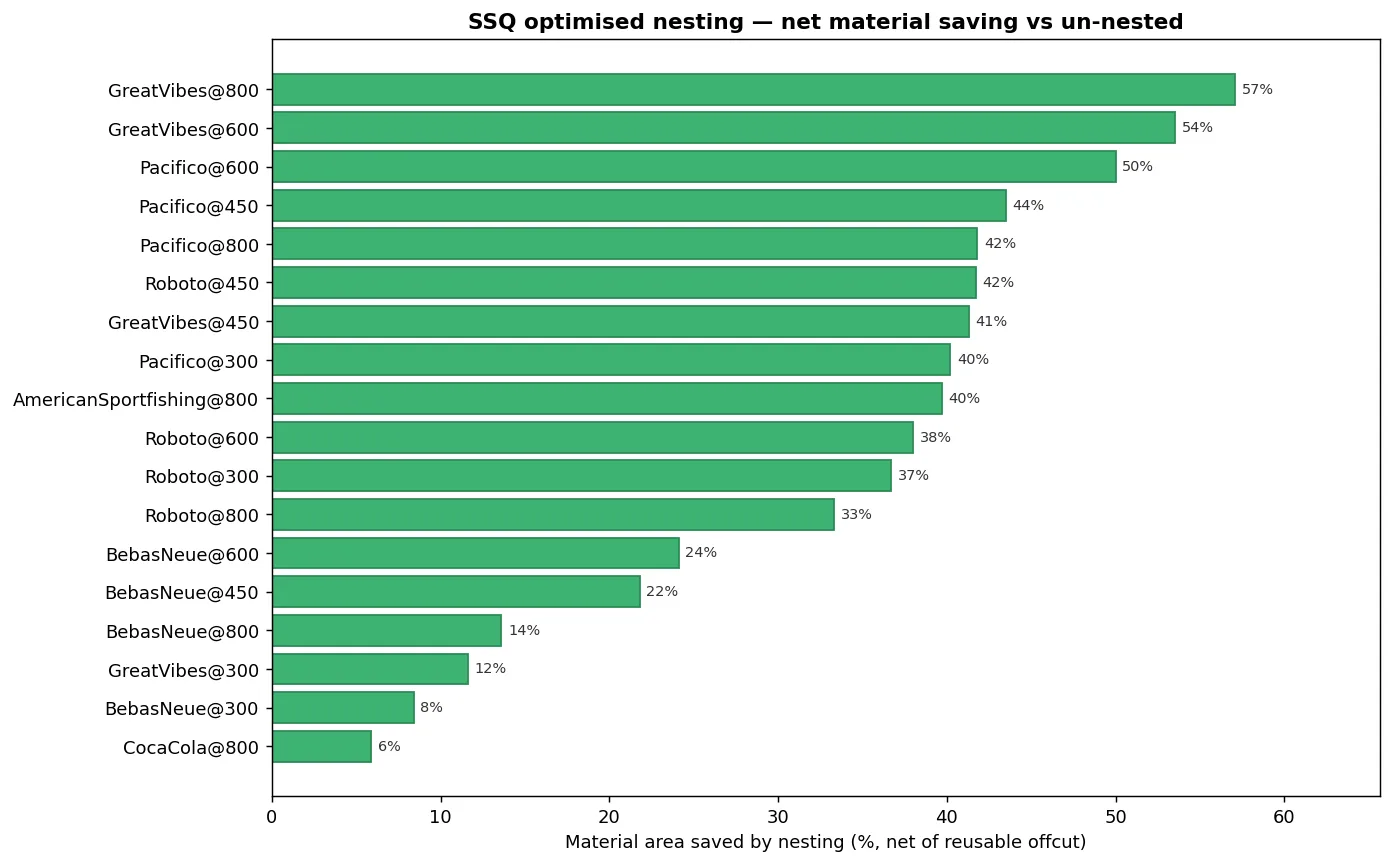
The standout cases were the connected scripts, where the swashes and tails of one letter drop neatly into the gaps of the next:


Why Does Sign Nesting Save More on Irregular Geometry?
The headline finding is counter-intuitive: the more irregular and contoured the artwork, the more nesting saves. Flowing script faces saved 40-57%; clean blocky type like Bebas Neue saved 8-24%. Awkward, organic shapes have deep concavities that a second awkward shape can nest right inside, so the sheet fills up far tighter than a row of near-rectangles ever could.
That matters because most quoting tools can only nest rectangles - they wrap every artwork in a bounding box and pack the boxes, which throws away exactly the interlocking space that complex geometry offers. SSQ's nesting is geometry agnostic: any size, any shape, any contour, nested together in the same run.
There is a reason this is hard. Nesting is an indeterminate maths problem - there is no single "correct" layout, only better and worse ones - so SSQ uses a machine learning algorithm that intelligently "nudges" overlapping geometry inside each other to pack tighter, all under the hood on every quote. We are engineers at heart and we love the mathematics, so our algorithms are probably a little over-engineered. That is fine, because it means the weird, contour-heavy jobs your competitors quote conservatively are exactly the ones you win on. For the deeper material-by-material picture this feeds into, see our ACM signs pricing guide.
This benchmark is fabricated lettering specifically, chosen because letters span the full range of signage geometry from rectangles to scripts. Simple rectangular jobs sit at the lower end of the savings range; contour-cut work and mixed multi-artwork orders sit higher. The ~33% average is what this set measured - your mix will land somewhere on the same curve.
This Runs on Every Quote, Automatically
Here is the part that turns a benchmark into money: none of this is a separate step you have to do. Your customer selects a product or drags and drops their artwork, SSQ nests the whole order across sheets to minimise waste, and that same optimised layout flows straight into a print-ready file with cut lines and layup done. The nesting you quoted is the nesting you cut.
That is the Toyota idea we build on - automate the repetitive work so your people do the valuable work. Nobody in your shop spends an afternoon juggling letters on a sheet to claw back a sheet of acrylic. The software does it on every quote, instantly, while your fabricators and designers get on with the jobs only they can do. Watch it nest a live order on the demo, or see the full feature breakdown.
What This Means for Your Shop
Better nesting is one of the few levers that improves margin and competitiveness at the same time, with no trade-off and no extra labour:
- Bank the margin - keep the ~33% material saving as profit on jobs you were winning anyway.
- Sharpen your price - pass it on to come in under shops still nesting by hand, without cutting into margin.
- Win the hard jobs - contour-heavy and script work, where the saving is biggest, is exactly where competitors quote high and you can quote sharp.
- Quote it instantly - the saving is calculated automatically, so there is no slow manual layout between an enquiry and an accurate price.
This applies well beyond letters - the same nesting runs on a bulk safety sign pack of mixed artworks, a set of custom illuminated logos, or any order of cut shapes. SwiftSignQuote prices it all from first principles - real material at real nested yield, automatically.
Ready to automate your sign shop quoting?
See how SwiftSignQuote can save you hours on every quote.
Book a 30-minute demo to see how SwiftSignQuote can transform your business.
Appendix: Full Benchmark Data
The complete per-layout figures are below, sorted by material saved. You can also download the raw benchmark CSV - every number in this post traces back to it.
| Typeface | Cap height (mm) | Traditional (m²) | Nested (m²) | Material saved |
|---|---|---|---|---|
| Great Vibes | 800 | 6.94 | 2.98 | 57.1% |
| Great Vibes | 600 | 3.76 | 1.75 | 53.5% |
| Pacifico | 600 | 5.95 | 2.98 | 50.0% |
| Pacifico | 450 | 2.69 | 1.52 | 43.5% |
| Pacifico | 800 | 8.50 | 4.94 | 41.8% |
| Roboto | 450 | 2.70 | 1.57 | 41.7% |
| Great Vibes | 450 | 2.11 | 1.24 | 41.3% |
| Pacifico | 300 | 1.20 | 0.72 | 40.2% |
| American Sportfishing | 800 | 2.73 | 1.64 | 39.7% |
| Roboto | 600 | 4.80 | 2.98 | 38.0% |
| Roboto | 300 | 1.20 | 0.76 | 36.7% |
| Roboto | 800 | 9.55 | 6.37 | 33.3% |
| Bebas Neue | 600 | 2.90 | 2.20 | 24.1% |
| Bebas Neue | 450 | 1.63 | 1.28 | 21.8% |
| Bebas Neue | 800 | 5.16 | 4.46 | 13.6% |
| Great Vibes | 300 | 0.94 | 0.83 | 11.6% |
| Bebas Neue | 300 | 0.73 | 0.66 | 8.4% |
| Coca-Cola | 800 | 2.09 | 1.96 | 5.9% |
All 18 benchmarked layouts, sorted by material saved - tap one to enlarge.
Want this saving on your own quotes? Try the live demo and watch a real order nest in front of you, or read the complete sign pricing guide for the first-principles method behind every number.
Frequently Asked Questions
How much material can nesting save on a sign job?
In our own benchmark of 18 fabricated-lettering layouts, SSQ autonesting saved about 33% of material on average versus a traditional as-drawn layout, with a median of 39% and a range of 6% to 57%. Every one of the 18 layouts improved. The saving depends on the geometry: irregular, contoured and script shapes interlock and save the most.
Does autonesting work on curved or contoured letter shapes?
Yes. The nesting is geometry agnostic - it handles any size, shape or contour, not just rectangles. In the benchmark, the most irregular geometry saved the most: flowing script lettering saved 40-57%, while blocky type saved 8-24%, because contoured shapes nest tightly inside each other's gaps.
Do I have to do anything to get nested layouts?
No. Nesting runs automatically on every quote. Your customer selects or uploads their artwork, SSQ nests the whole order across sheets, and the same optimised layout flows straight into a print-ready file. There is no separate nesting step and no manual layout to do.
Does better nesting actually increase margin?
Yes, directly. Material is a hard cost on every sign job, so using about a third less of it is found margin. You can bank that saving as extra profit, or pass it on to quote a lower material price and win more work - without touching your margin.


